
Last Updated: July 2026
Published by: oncosolution — a specialist oncology medicine supplier serving patients, pharmacies, and distributors worldwide.
Medical Review: Reviewed by Dr. Nusrat Jahan, MBBS, MD (Medical Oncology)
Content Basis: This article is based on official prescribing information, product monographs, and regulatory product documentation from DGDA (Directorate General of Drug Administration, Bangladesh).
Sources: beaconmedicare.com.bd, accessdata.fda.gov, accessdata.fda.gov, drugs.com
Key Takeaways
Axinix (Axitinib) is a tyrosine kinase inhibitor manufactured by Beacon Pharmaceuticals Ltd. in Bangladesh and supplied directly to the domestic market for the treatment of advanced renal cell carcinoma in adult patients aged 18 years and above.
Axinix is approved across three clinical settings: as monotherapy after failure of one prior systemic therapy, and as a first-line treatment in combination with either avelumab or pembrolizumab.
Its mechanism of action involves selective inhibition of VEGFR-1, VEGFR-2, and VEGFR-3, disrupting the angiogenic signalling pathways that tumours rely on for blood supply and growth.
Common adverse effects include hypertension, diarrhea, fatigue, nausea, and thyroid dysfunction; serious adverse events such as hypertensive crisis, arterial and venous thromboembolic events, and hemorrhage require close clinical monitoring throughout treatment.
Axitinib is primarily metabolised via the CYP3A4 pathway — strong inhibitors and inducers of this enzyme should be avoided, and any necessary co-administration requires physician-directed dose adjustment.
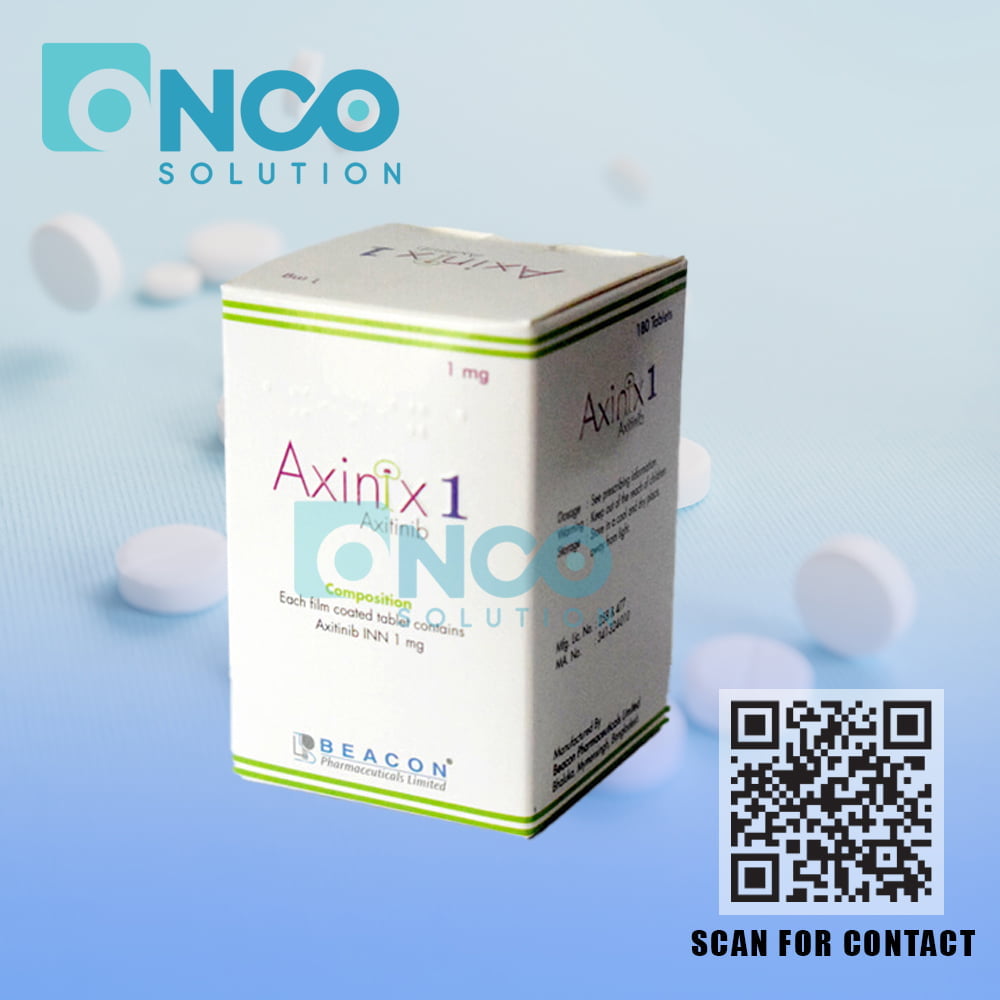
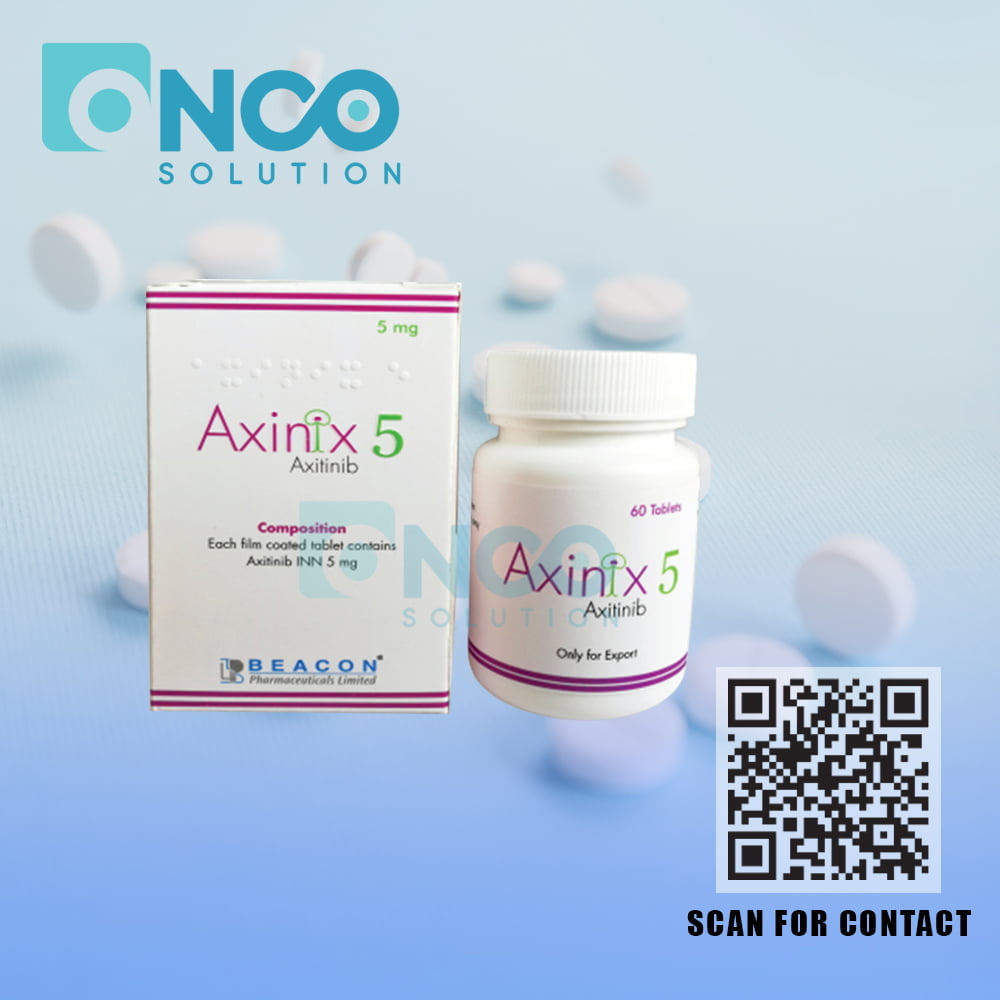
Axinix is available as film-coated tablets in 1 mg and 5 mg strengths, supplied in 60’s pot and 180’s pot pack sizes to accommodate both short-term dispensing and longer-term institutional supply needs.
What Is Axinix (Axitinib)?
Axinix is an antineoplastic tyrosine kinase inhibitor manufactured by Beacon Pharmaceuticals Ltd. (Bangladesh) and supplied directly to the Bangladeshi market. Its active pharmaceutical ingredient, Axitinib, belongs to the therapeutic class of antineoplastic agents and tyrosine kinase inhibitors — a category of targeted oncology medicines designed to interfere with specific molecular pathways that drive tumor development.
Axinix is formulated as film-coated tablets and is available in two strengths: 1 mg and 5 mg. Both strengths are supplied in pot pack configurations of 60 tablets and 180 tablets, providing flexibility for hospital formularies, oncology clinics, and pharmaceutical distributors managing varying patient volumes. As a domestically manufactured product, Axinix offers a reliable procurement option for healthcare institutions across Bangladesh seeking a locally sourced axitinib tablets supplier.
Approved Indications for Advanced Renal Cell Carcinoma
Axinix (Axitinib) is indicated for the treatment of advanced renal cell carcinoma (RCC) across three distinct clinical settings, all approved for adult patients aged 18 years and above.
1. Monotherapy after prior systemic therapy failure: Axitinib (INLYTA) is approved as a monotherapy for adult patients with advanced renal cell carcinoma following the failure of one prior systemic therapy. This indication positions it as a second-line treatment option for patients whose disease has progressed on an initial systemic regimen.
2. First-line combination with avelumab: Axitinib is approved for use in combination with avelumab, a PD-L1 checkpoint inhibitor, as a first-line treatment for adults with advanced renal cell carcinoma. This combination approach leverages both antiangiogenic and immunotherapeutic mechanisms to address the disease at initial presentation.
3. First-line combination with pembrolizumab: Axitinib (Inlyta) is also approved in combination with pembrolizumab, a PD-1 checkpoint inhibitor, as a first-line treatment for adults with advanced renal cell carcinoma. This regimen similarly integrates targeted therapy with immune checkpoint blockade for newly diagnosed advanced disease.
All three indications are relevant for oncology procurement teams supplying treatment programs for advanced RCC in adult patients.
Mechanism of Action: Targeting Tumor Angiogenesis
Axitinib exerts its antitumor effect through selective inhibition of vascular endothelial growth factor receptors — specifically VEGFR-1, VEGFR-2, and VEGFR-3. These receptor tyrosine kinases play a central role in pathologic angiogenesis, the process by which tumors stimulate the formation of new blood vessels to sustain their growth and proliferation.
By binding to and inhibiting these receptors, Axitinib disrupts the signaling cascades that drive tumor vascularization. Without an adequate blood supply, tumor cells are deprived of the oxygen and nutrients required for sustained growth, effectively slowing or halting cancer progression.
VEGFR-2 is considered the primary mediator of angiogenic signaling in endothelial cells, while VEGFR-1 and VEGFR-3 contribute to additional aspects of vascular and lymphatic remodeling within the tumor microenvironment. The selective inhibition of all three receptors by Axitinib provides a comprehensive blockade of VEGF-driven angiogenic pathways, making it a mechanistically well-defined agent in the management of advanced renal cell carcinoma.
This targeted mechanism underpins its clinical utility both as monotherapy and in combination with immune checkpoint inhibitors, where complementary modes of action may enhance overall treatment outcomes.
Product Specifications
The following table summarises the key product specifications for Axinix as supplied through our Bangladeshi procurement channel:
| Brand Name | Axinix |
|---|---|
| Generic Name | Axitinib |
| Manufacturer | Beacon Pharmaceuticals Ltd., Bangladesh |
| Therapeutic Class | Antineoplastic Agent; Tyrosine Kinase Inhibitor |
| Available Strengths |
1 mg tablet ; 5 mg tablet |
| Dosage Form | Film-coated tablet |
| Pack Sizes | 60’s pot; 180’s pot |
| Sourcing | Sourced directly from Bangladeshi manufacturers |
Both the 1 mg and 5 mg tablet strengths are maintained in inventory to support the full range of clinical requirements for advanced renal cell carcinoma treatment programs. The 60’s and 180’s pot pack options accommodate both short-term dispensing needs and longer-term institutional supply arrangements.
Safety Profile and Important Clinical Considerations
Healthcare procurement professionals and clinical teams should be familiar with the established safety profile of Axitinib when evaluating Axinix for formulary inclusion or patient supply.
Common adverse effects reported with Axitinib include hypertension, diarrhea, fatigue, nausea, vomiting, hemorrhage, thyroid dysfunction, and wound healing complications. These effects are consistent with the pharmacological class and are typically managed through clinical monitoring and supportive care under physician supervision.
Serious adverse events associated with Axitinib include hypertensive crisis, arterial thromboembolic events, venous thromboembolic events, gastrointestinal perforation, fistula formation, reversible posterior leukoencephalopathy syndrome (RPLS), hepatotoxicity, and major adverse cardiovascular events (MACE). Patients receiving Axinix should be monitored closely for these conditions throughout the course of treatment.
Drug interactions — CYP3A4/5 pathways: Axitinib is metabolised via CYP3A4/5 pathways. Co-administration with strong CYP3A4/5 inhibitors should be avoided; if unavoidable, dose adjustment is required as directed by the treating physician. Strong CYP3A4/5 inducers should also be avoided, as they may significantly reduce Axitinib plasma concentrations and compromise therapeutic efficacy.
Reproductive and lactation considerations: Axitinib may impair fertility in both males and females of reproductive potential. Use during pregnancy is not advised. Prescribers should counsel patients accordingly.
Clinical guidance: All dosing decisions, modifications, and clinical management protocols should be determined by the treating physician in accordance with the official prescribing information.
Regulatory Status of Axitinib
Axitinib has a well-established global regulatory history. The United States Food and Drug Administration (FDA) first approved Axitinib in for the treatment of advanced renal cell carcinoma following failure of one prior systemic therapy. In , the FDA expanded this approval to include first-line advanced RCC in combination with checkpoint inhibitors, reflecting the growing body of clinical evidence supporting combination immunotherapy-based regimens.
Globally, Axitinib is widely recognised as an established antineoplastic agent — it is the active ingredient in Inlyta, the originator product — and its clinical profile is well-documented across international oncology guidelines.
In Bangladesh, pharmaceutical products are regulated by the Directorate General of Drug Administration (DGDA), accessible at dgda.gov.bd. The DGDA governs the approval, registration, and distribution of medicinal products within the domestic market. Axinix, manufactured by Beacon Pharmaceuticals Ltd., is supplied in compliance with the applicable regulatory framework governing pharmaceutical products in Bangladesh.
Why Source Axinix from a Bangladeshi Supplier?
Axinix is manufactured and supplied directly from Bangladesh by Beacon Pharmaceuticals Ltd., making it a domestically sourced option for hospitals, oncology centres, pharmacies, and healthcare distributors operating within the country. Procuring from a local manufacturer-linked supply chain reduces dependency on cross-border logistics and supports more predictable inventory management for critical oncology medicines.
For B2B procurement teams, sourcing Axinix through a Bangladeshi supplier offers several practical advantages. Both the 1 mg and 5 mg tablet strengths are available, ensuring that clinical programs requiring either strength can be consistently fulfilled. The availability of both 60’s pot and 180’s pot pack sizes further supports flexible ordering aligned with institutional dispensing volumes.
Direct domestic supply also facilitates more responsive communication between procurement teams and the supply source, enabling faster confirmation of stock availability and order fulfilment timelines — a meaningful consideration for oncology departments managing ongoing patient treatment schedules.
For institutions also procuring other targeted oncology agents, our portfolio extends to additional tyrosine kinase inhibitors available through the same domestic supply channel.
How to Enquire About Axinix Supply and Pricing
Hospitals, pharmacies, oncology procurement teams, and pharmaceutical distributors in Bangladesh are invited to contact us directly to confirm availability and obtain pricing information for Axinix (Axitinib) tablets.
Both the 1 mg and 5 mg tablet strengths are available, supplied in 60’s pot and 180’s pot pack configurations. Whether your requirement is for a single-cycle supply or a longer-term institutional arrangement, our B2B procurement team is equipped to assist.
Please use the contact form or inquiry channel on this website to submit your request. Include your required strength, pack size preference, and estimated volume to enable a prompt and accurate response from our supply team.
Frequently Asked Questions
What is Axinix used to treat?
Axinix (Axitinib) is used to treat advanced renal cell carcinoma in adult patients aged 18 years and above, either as a monotherapy after one prior systemic therapy has failed or as a first-line treatment in combination with the checkpoint inhibitors avelumab or pembrolizumab.
What are the common side effects patients may experience with Axinix?
Patients taking Axinix may commonly experience hypertension, diarrhea, fatigue, nausea, vomiting, and thyroid dysfunction, among other effects; all side effects should be reported to and managed by the treating physician throughout the course of treatment.
Are there any serious risks associated with Axinix that patients should be aware of?
Yes — serious adverse events associated with Axitinib include hypertensive crisis, arterial thromboembolic events, hepatotoxicity, and reversible posterior leukoencephalopathy syndrome (RPLS), which is why close clinical monitoring is required throughout treatment.
Can Axinix be taken alongside other medications?
Axitinib is metabolised via CYP3A4/5 pathways, so strong inhibitors or inducers of these enzymes should be avoided where possible; if co-administration is unavoidable, the treating physician must determine any necessary dose adjustments based on the official prescribing information.
How can hospitals and oncology centres in Bangladesh procure Axinix?
Axinix is sourced directly from Bangladeshi manufacturers and is available to hospitals, oncology centres, pharmacies, and distributors in Bangladesh by submitting an enquiry through the contact form on this website, specifying the required strength, pack size, and estimated volume.
What pack sizes and strengths of Axinix are available for institutional procurement?
Axinix is available in both 1 mg and 5 mg film-coated tablet strengths, supplied in 60’s pot and 180’s pot pack configurations to support flexible ordering for varying institutional dispensing volumes and treatment programme durations.
Access This Medicine Through oncosolution
We are a specialist oncology medicine supplier delivering to patients, pharmacies, hospitals, and distributors worldwide. Contact us for availability and sourcing support.
We do not publish prices online. All pricing is provided directly by our specialist supply team on request.
Medical Information Notice: This content is for informational purposes only and is based on official pharmaceutical product documentation. It does not constitute medical advice. Patients should consult their doctor or pharmacist before taking any medication.
Regulatory Disclaimer: Sourcing and distribution are subject to regional import regulations, quotas, and verified medical prescriptions where applicable. Pricing and availability are subject to change without notice.
Content Currency: This article was last reviewed and updated in July 2026. Regulatory approval statuses and product availability are subject to change; readers are advised to consult official regulatory databases for the most current information.